
Hi dear one.
If you’ve used ChatGPT to draft an email, asked Siri for the weather, or amazed at a Midjourney image, you might think we have arrived at the peak of artificial intelligence.
We haven’t. We are just at the foothills.
While today’s AI tools are mind-bendingly impressive, they are fundamentally different from human intelligence. There is a massive conceptual gap between the AI we have now and the AI science fiction has promised us.
To understand the future of technology and humanity’s place within it, you need to understand that gap. You need to understand the difference between Narrow AI and AGI.
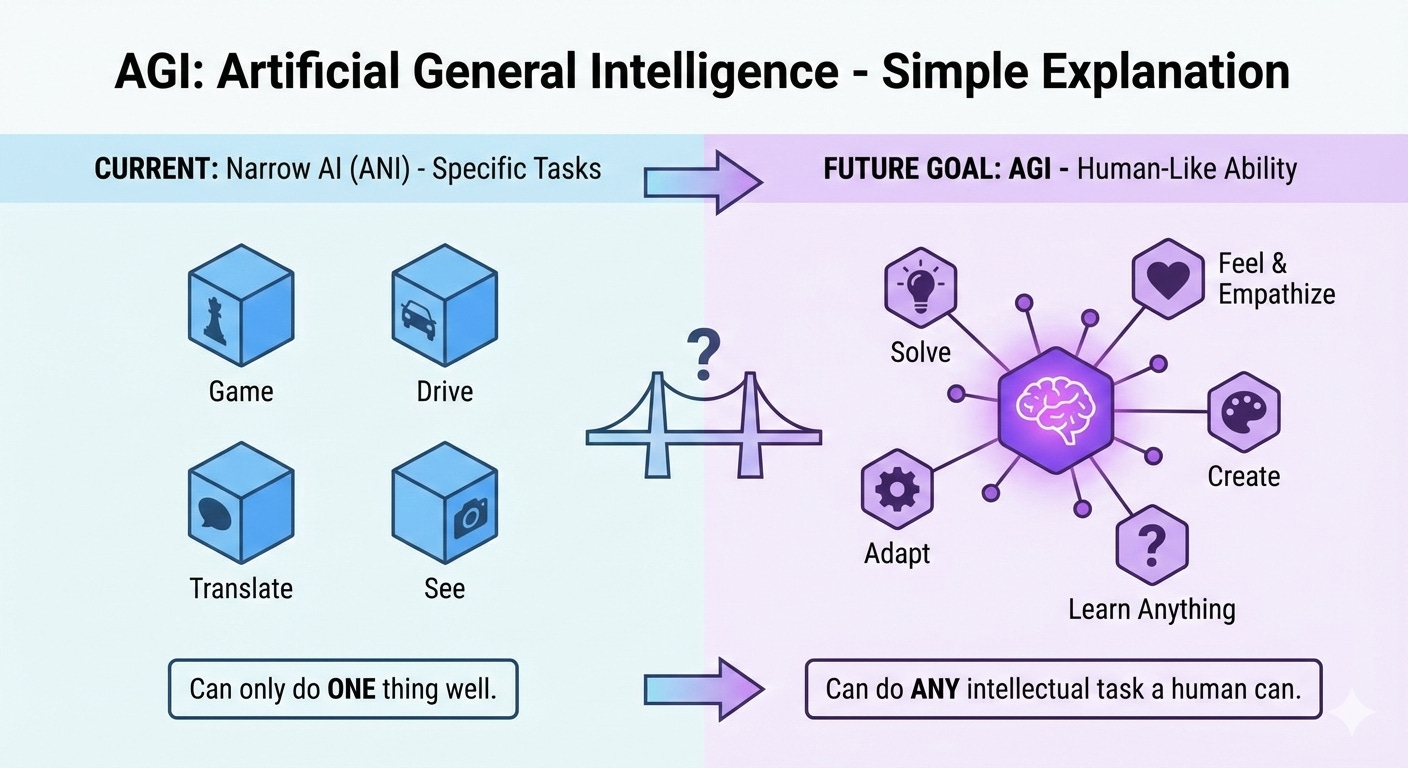
Let’s break it down using the infographic above as our guide.
Where We Are: Narrow AI (ANI)
Look at the left side of the image (the blue section). This is the world we live in today.
We are currently in the era of Artificial Narrow Intelligence (ANI). The keyword here is “Narrow.”
Today’s AI models are highly specialized savants. They are trained painstakingly to excel at very specific tasks. As the graphic shows, we have brilliant systems housed in separate, disconnected boxes:
Game: We have AI that can crush the world’s best human players at Chess and Go.
Drive: We have software that can keep a Tesla in its lane on a highway.
Translate: We have tools that instantly turn spoken English into Spanish text.
These systems are incredible achievements. In their specific domains, they often vastly outperform humans. But they are brittle. The AI that beats a grandmaster at chess cannot drive a car. The AI that translates languages cannot diagnose a disease.
As the image summarizes at the bottom left: Today’s AI “Can only do ONE thing well.” Take it out of its comfort zone, and it fails instantly.
The Goal: AGI (Human-Like Ability)
Now, look at the right side (the purple section). This is the dream: Artificial General Intelligence (AGI).
AGI is not just a faster version of what we have now. It is a fundamental shift in capability. It represents an AI that possesses human-level cognitive flexibility.
Instead of separate boxes for separate skills, AGI is depicted as a central brain that can connect to any type of task, just like you can. If you look at the capabilities surrounding the AGI brain in the graphic, you see the things today’s machines struggle with:
Adapt & Learn Anything: A human can learn strategic thinking in chess today and apply it to business negotiations tomorrow. AGI could do the same, entering novel situations and figuring them out without prior specific training.
+1
Create & Feel: Instead of just remixing existing data, AGI implies the ability to genuinely innovate, understand emotional context, and perhaps possess common sense, the ultimate frontier of AI research.
The definition at the bottom right is the ultimate benchmark: A system that “Can do ANY intellectual task a human can.”
The Human Question: Where Do We Fit?
This definition leads to the most uncomfortable question of our time. If we create a machine that can perform any intellectual task a human can, and eventually do it faster, cheaper, and better without needing sleep, where does that leave us?
The arrival of AGI isn’t just a technological milestone; it’s a philosophical and ethical earthquake.
The Purpose Crisis: If the icons on the right, Solve, Create, Learn, can be automated, the concept of human labor changes drastically. We aren’t just talking about replacing blue-collar jobs; we are talking about replacing doctors, lawyers, researchers, and artists. What does human society look like when work is optional?
The Alignment Problem: If we create an entity super-intelligent enough to adapt to any situation, how do we ensure its goals coincide with ours? An AGI that is highly capable but doesn’t share human values could be catastrophic. We need to ensure the bridge to AGI is built on a foundation of human ethics.
Power and Inequality: Who owns the AGI? If one company or nation crosses that bridge first, they possess the most powerful tool in history. Will AGI solve global poverty, or will it create an unprecedented divide between those who control the intelligence and those who are made redundant by it?
The Great Unknown Bridge
The most important part of this entire infographic is the center.
There is a bridge connecting today’s Narrow AI to tomorrow’s AGI. Notice what’s sitting on top of it? A giant question mark.
We do not currently know how to cross that bridge. Many researchers believe that simply making current models bigger won’t work; we may need entirely new scientific breakthroughs to achieve genuine reasoning and understanding.
We are standing on one side, building incredible tools. The other side promises a world transformed. The challenge right now isn’t just building the bridge, it’s ensuring that what crosses it is beneficial to humanity.
Until next time.
Stay grateful and curious,
Kim
Loxie you are a God sent Angel of my heart's divine!!!!!,
It seems we are approaching another "Atlantis Moment"! As for what is going on, we need to think Big Picture more on a Galactic scale!! There are so many missing pieces to The Puzzle we Normies have no clue what is really playing out!!