
Hi dear friend.
I’ve been thinking, reading and listening to a lot of pod casts lately, about where my mind actually lives during the day. And it’s rarely just here.
Sometimes it’s in the past. Replaying a conversation. Wondering why I said or did this and that. Feeling something that happened years ago as if it happened today.
The other half is a lot in the future. Planning, worrying, wishing, hoping... Making lists of how life will be when things finally settle down.
Reaching for the future… but not really creating it.
Because when I think about my future, I usually think about it with the same old feelings, the same worry, the same “yes, but maybe.” The same old story. So, I’m basically planning a new life using my old brain.
Remembering my future
What if, instead of hoping for the woman I’m becoming, I practise remembering her? The way I remember the taste of my morning tea or hearing my kids laugh together. Fully, in my body, as if it already happened.
It sounds a little strange, but it turns out the brain is pretty good at it.
Meet the four brains
Dr. Jill Bolte Taylor is a neuroanatomist, a brain scientist, who had a stroke in 1996. She lost her language, her logic, her sense of time… and even her sense of where her body ended and the world began.
What remained was the right side of her brain. She described it as an ocean of peace. It took her eight years to rebuild. Out of that came her books My Stroke of Insight and Whole Brain Living.
In Whole Brain Living she explains that each half of the brain has a thinking part on top (the cortex) and a feeling part underneath (the older limbic system). Two halves, two layers… four characters.
She also reminds us that we are feeling creatures who think, not thinking creatures who feel. The feelings get there first. The thinking arrives a moment later and writes the explanation.
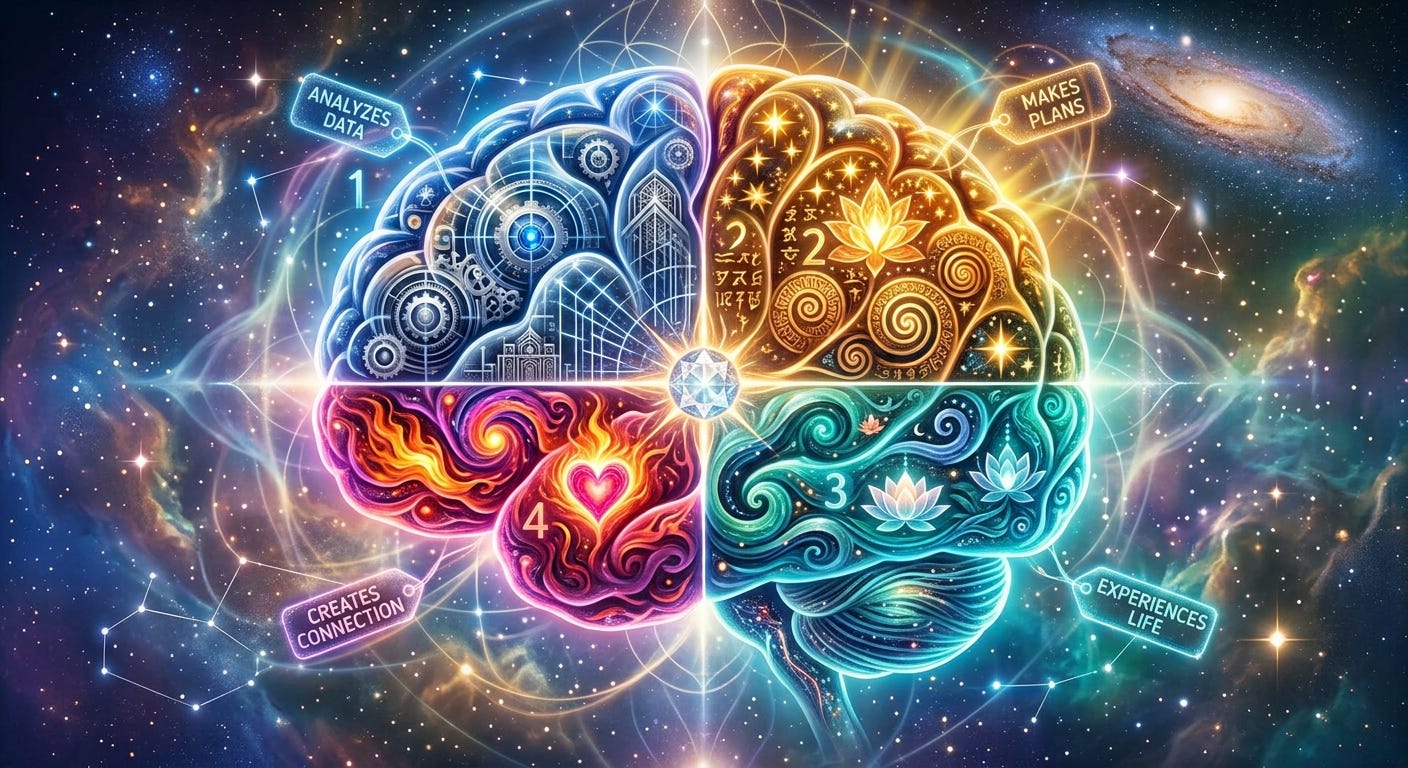
Character 1, the left thinking brain
This is the part of us that thinks in words, steps and details. One thing after another. She lives in time, always aware of what happened before and what needs to happen next.
She sorts, labels, compares and judges. Right and wrong. Good and bad. Mine and yours. She is also where our sense of being a separate “I” comes from. Her job is to build and run our life in the world. Plans, money, structure, getting things finished.
When she’s out of balance, she becomes rigid and critical. She can’t rest until everything is done. And everything is never done.
Character 2, the left emotional brain
This part compares everything happening now with everything that happened before. Her question is always the same.
Is this safe?
She checks every person, situation and feeling against her library of old experiences, especially the painful ones. If something looks even a little bit like an old hurt… alarm bells.
This is where we feel fear, anger, shame, guilt and that old familiar “not enough.” It’s where our inner child carries the past. It’s our fight or flight. Her job is protection. She sets boundaries, says no and keeps us alive. We need her. The trouble starts when she runs our life using memories that are twenty years out of date.
Character 3, the right emotional brain
This part lives right now, through the senses. Colour, music, taste, touch, sun on our skin. She’s curious, playful and spontaneous. She wants to explore, create, laugh, hug and try something new just because it looks fun.
This is where we feel joy, wonder, delight and connection with other people. Her job is to make life worth living.
When she’s out of balance she can forget about consequences altogether… which is why she and Character 1 need to be on speaking terms.
Character 4, the right-thinking brain
This part sees the whole picture instead of the details. No past, no future, only now. No hard edges between “me” and everything else.
This is where Jill landed during her stroke, when the left side went quiet. It’s where we feel gratitude, compassion, peace and the sense of being part of something much bigger. Her job is to remind us that we belong to the whole… and that in this moment, we are fine.
Giving them names
In a podcast I listened to Jill was talking about giving each character their own name.
I love this!🥰
Because in the middle of a stressful moment, “Character 2” doesn’t exactly roll off the tongue. But a name does. And the second I can say “oh, that’s her talking,” I’m already halfway out of whatever reaction I go through.
So here’s my brain household.
Character 1 is Victoria. She has the clipboard.
Character 2 is the Cousin. She always remembers what happened last time.
Character 3 is Gladys. She’s painting in the studio having fun.
Character 4 is Zenita. She’s sitting quietly smiling, completely at peace and very content.
Jill’s whole point is that we need all four. Whole brain living simply means noticing who’s in charge right now and inviting the others to the table.
She has a lovely tool called the Brain Huddle, built on BRAIN (Breathe, Recognize, Appreciate, Inquire, Navigate). Breathe. Notice who’s talking. Thank her for trying to help. Ask the others what they think. Then move forward together.
She also teaches the 90 second rule. When an emotion gets triggered, the chemistry of it moves through the body in about 90 seconds.
If it’s still there after that?
We’re usually feeding it.
Rereading the old script.
The old roads
Our brains are incredibly clever things. They are also creatures of habit. Give the brain a thought often enough, a feeling often enough, a behaviour often enough and eventually it starts doing it for us.
Automatically, no meeting, no permission. No little committee sitting around asking, “Are we sure this is still serving her?”
It just runs the programme.
· I reach for my phone before my feet have touched the floor.
· Someone asks how I am and “fine” pops out before I’ve checked.
· A bill arrives and my stomach drops, as if I’m seven years old and money is tight again.
· A friend doesn’t reply for a day and Character 2, (the left emotional brain) has already written a whole novel about what I did wrong.
· Someone uses a certain tone of voice… and I’m twelve, standing in the kitchen, in trouble.
· Once upon a time someone said “you’re not creative” and decades later the words still come out of our mouths.
None of it is happening now. It’s memory, on repeat, creating real feelings in a real body today. It can feel like we’re choosing. But a lot of the time we’re simply running an old programme.

Joe Dispenza and the rewiring
This is where Dr. Joe Dispenza comes in. His books Breaking the Habit of Being Yourself, You Are the Placebo and Becoming Supernatural all circle one big idea.
We can change our brain on purpose.
Thoughts are the language of the brain. Feelings are the language of the body.
We think a thought, the brain releases chemistry, and we feel a matching feeling. Then that feeling makes us think more of the same thoughts. And round and round it goes.
Do that for enough years and the body memorises the emotion. It runs the loop by itself. Dispenza says that by our mid-thirties, most of who we are is a collection of memorised behaviours, emotional reactions and beliefs running quietly in the background.
He also points out that most of the thoughts we think today are the same ones we thought yesterday.
Same thoughts… same choices.
Same choices… same behaviours.
Same behaviours… same experiences.
Same experiences… same feelings.
And our future ends up looking an awful lot like our past.
But the good news is, the brain can change.
All our life. That’s neuroplasticity.
Neurons that fire together wire together. And, as Dispenza loves to add, neurons that no longer fire together no longer wire together.
Old paths we stop using start to fade. New ones get stronger every time we walk them. He calls it pruning and sprouting, like tending a garden.
And the brain doesn’t even need the real event to start wiring.
In a well known 1995 study, neurologist Alvaro Pascual Leone had one group practise a short piano piece for five days, while another group only imagined practising it.
Both groups showed similar changes in their brains. Imagination changed the wiring.
That is remembering our future. Dispenza calls it mental rehearsal. We close our eyes and live the new version of ourselves, in detail, with real feeling, again and again… until the brain starts treating it as familiar.
As something it already knows.
The secret ingredient is emotion. Victoria can write the affirmation on a sticky note. But if Gladys doesn’t feel it and Zenita doesn’t rest in it… not much happens.
Gratitude, joy and love are the feelings that tell the body this future is already on its way. Yes, it takes some work, but its fun work.
The old road won’t vanish overnight. Some mornings I’m back on it before I’ve brushed my teeth.
A path paved over thirty years doesn’t turn into a meadow after one meditation. And Dispenza says the trickiest moment comes right when we stop making the familiar choice. The body protests. The unknown feels uncomfortable.
That wobble isn’t failure. It’s the sound of a new path being cleared.
So I’ve made it more playful.
In the morning, before the phone, I sit for a few minutes and visit her. Future me. I pick one ordinary moment from her day and I feel it.
When the Cousin starts telling an old story, I greet her. “Hello there, I see you.” Then I give it 90 seconds.
I mix things up on purpose. I try brushing my teeth with the left hand. I water the garden in a different order. I sit in a different chair. Tiny surprises that tell my brain we are not on autopilot today.
And every day, Gladys (Character 3) gets to choose one thing purely for joy. Watching a new stand up comedian. A happy messy painting. Joy and love is the best fertiliser I know for new wiring.
The whole table
These days change feels less like a battle and more like a family dinner where even the difficult cousin (Character 2) is welcome.
Victoria sets the table.
The Cousin gets a seat and a thank you for keeping us safe all these years.
Gladys brings the music.
Zenita lights the candles.
And there’s one more guest arriving. She already knows the way, because she’s the woman I’m remembering into being.
So now I’m curious… what names will you give your Character 1, 2, 3 and 4?
Until next time.
Stay grateful and curious.
Light and joy,
Kim
PS. A little something for my supporting subscribers
If you’re a paid supporting subscriber, you’ll also receive an audio version of my writing, so you can listen instead of read, whether you’re walking, relaxing, or simply letting the words sink in.
Thank you for supporting my work and helping me keep creating and sharing these thoughts with you.